
The Culture of Culture
What is culture, really? Where did the idea come from, who built it, and what kind of world would exist without it? A reflection from the streets of Warsaw.
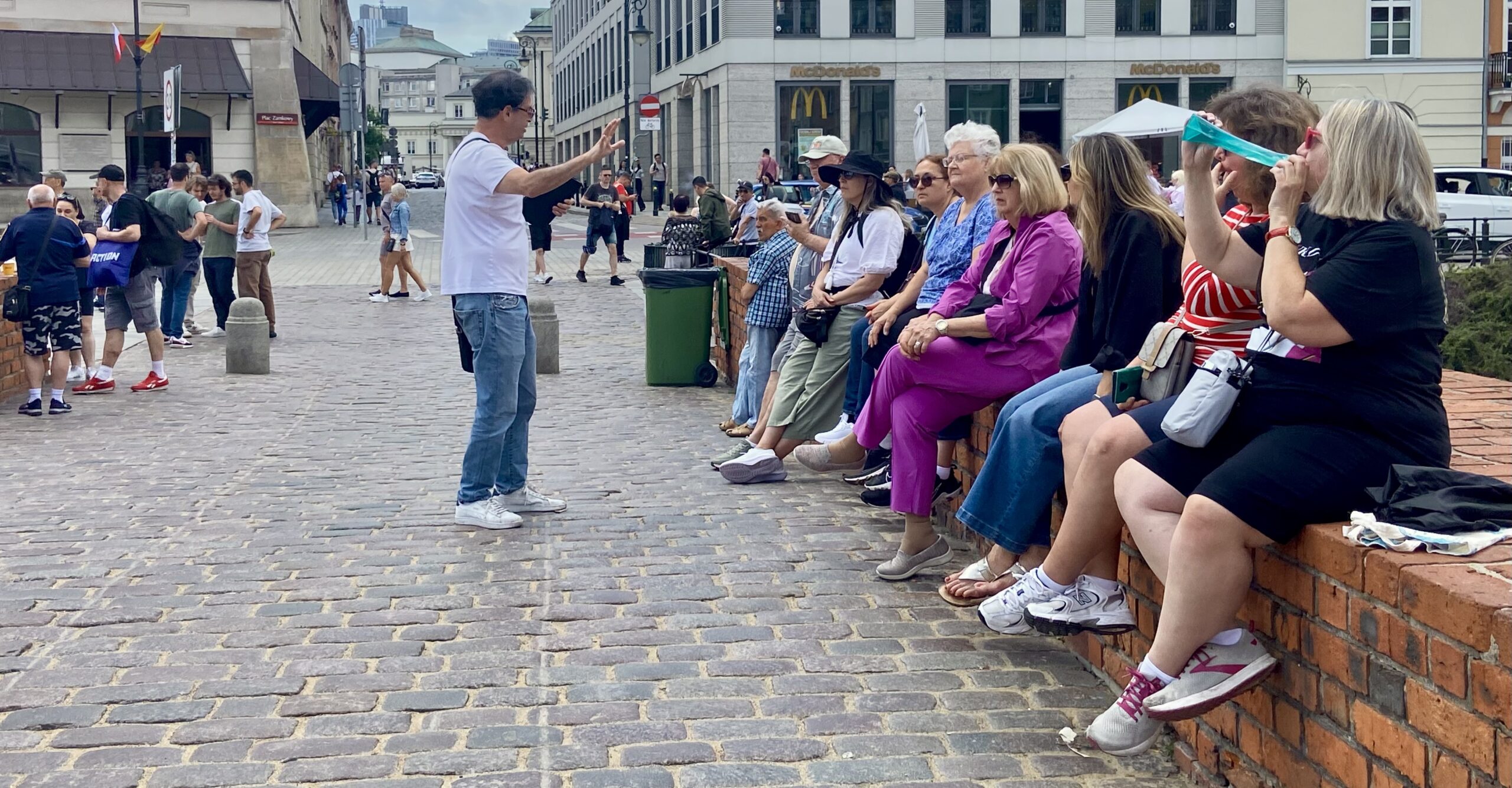
During a recent PTPI walking tour through Warsaw, a question emerged that refused to stay small. We were admiring the beauty of what surrounds us in that extraordinary city - the architecture rebuilt from rubble, the music that survived occupation, the language that outlasted every attempt to erase it - when someone asked what felt like a simple question.
What is culture, actually? Not the museums and festivals and folk costumes we were passing. But the thing beneath them. The thing that made people rebuild Warsaw exactly as it was, stone by stone, after it had been deliberately destroyed.
And then: when did we start calling it that?
In several democracies in recent years, a growing political tendency has treated culture - particularly minority culture, indigenous culture, and the cultures of newcomers - as a threat to be managed rather than a resource to be valued. The argument, roughly, is that cultural diversity weakens cohesion; that shared identity requires cultural uniformity. This reflection is not a direct rebuttal to that argument. It is something quieter and, perhaps, more lasting - an attempt to understand what culture actually is, where it came from, who carried it forward, and what would be left without it.
The short answer to the last question is: not much worth visiting.
Culture Before We Had a Word for It
Human beings have always had culture. Long before there were countries, governments, universities, or written histories, there were shared ways of living. People learned how to hunt, celebrate, mourn, worship, raise children, resolve disputes, and pass knowledge from one generation to the next.
Culture existed before we had a word for it. It was simply what it meant to belong to a group of people rather than to be alone in the world.
The modern idea of culture as a distinct concept began to form during the Enlightenment and grew substantially during the 19th century, when thinkers started asking why different societies had developed such different customs, beliefs, and ways of organising themselves. It was, in some ways, the first serious attempt to understand human diversity from the outside rather than simply living inside it.
"That complex whole which includes knowledge, belief, art, morals, law, custom, and any other capabilities and habits acquired by man as a member of society."
Tylor's definition remains, remarkably, one of the most useful we have. It does not reduce culture to art or food or costume. It names it as the entire complex of learned human behaviour - everything that is passed from person to person rather than written in our biology. Everything, in other words, that distinguishes a community from a collection of individuals.
The Cultures We Often Overlook
When people hear the word culture, most reach immediately for the national version. French culture. Japanese culture. Polish culture. Kenyan culture. These are real and important. But culture exists at every scale of human organisation, and we often fail to notice the ones closest to us.
How decisions are made, how conflict is handled, what is said at the table and what is never mentioned.
Whether people are trusted or monitored, whether failure is hidden or examined, whether the loudest voice or the best argument wins.
The rituals, calendars, obligations, and shared stories that give time its rhythm and life its meaning.
The music, language, codes, and loyalties that mark the boundary between generations and create the first sense of belonging outside the family.
The newest and least examined culture - shaping attention, language, status, and social norms at extraordinary speed.
The unwritten rules that determine what is actually rewarded, what is actually punished, and who actually belongs.
Culture shapes how we greet each other, how we make decisions, how we deal with conflict, what we celebrate, and what we consider important. And crucially: we only tend to notice it when we encounter a different one. Culture is, in this sense, the water we swim in - invisible until we leave it.
It is also worth saying clearly that culture is not a museum exhibit. It is not fixed, inherited whole, or identical across generations. Today's digital communications, mass migration, international travel, and global media mean that cultures are constantly absorbing, adapting, and transforming. The Polish culture that rebuilt Warsaw is not identical to the culture that produced Chopin, which is not identical to the culture of the Solidarity movement, which is not identical to the culture of Warsaw's young people today. Culture evolves because people do - and that evolution is not loss. It is how cultures stay alive.
Why Travel Is an Encounter with Another Way of Being Human
Travel is often described as seeing new places. In reality, it is better understood as encountering different ways of being human.
When we arrive somewhere genuinely different, we discover that many things we had assumed were simply normal - the way people eat, the way they express respect, the way they organise family life, the way they think about time - are actually cultural choices. They are not laws of nature. They are accumulated human decisions about how to live, refined over generations.
Travel teaches humility. It reminds us that our own way is not the only way. And that realisation is often the beginning of understanding.
This is precisely why a world in which all cultures had converged into a single way of living would offer so little reason to travel. Every destination would feel essentially like home. The friction that produces curiosity, and the curiosity that produces understanding, would be largely absent. We would have gained efficiency and lost something much harder to replace.
The Great Cultural Builders History Tends to Forget
History remembers kings, presidents, generals, and inventors. The people who actually made and transmitted culture are almost entirely invisible in official records. Not because their contribution was smaller - it was usually larger - but because cultural transmission happens through thousands of ordinary acts rather than single decisive moments.
The griot of West Africa, who carried the genealogies, histories, and moral frameworks of entire peoples in memory and voice. The calligrapher who codified a script and made literacy portable across a continent. The grandmother who kept a language alive in a kitchen when the school and the state were trying to replace it. The elder who held generations of ecological knowledge and taught it with the patience it required. None of these people have Wikipedia entries. All of them shaped the world more profoundly than most who do.
Several thinkers also made culture legible to those examining it from outside - and their work made it harder to dismiss or rank human diversity.
But for every name we can attach to the transmission of culture, there are thousands we will never know. The grandmother who kept a language alive. The schoolteacher who passed on a sense of history. The musician who preserved a tradition by making it beautiful enough for the next generation to want it. Culture survives because ordinary people choose to share it.
What Would a World Without Culture Actually Look Like?
It is a thought experiment worth taking seriously.
The inventory of loss
- Folk music and oral tradition
- Regional cuisine and culinary knowledge
- Indigenous languages and their embedded knowledge
- Ritual and ceremony - the marking of birth, death, and transition
- Architecture as the expression of place and identity
- Literature in every language except the dominant one
- The diversity that makes travel worth undertaking
- The shared memory that makes communities more than crowds
- The aesthetic traditions that make beauty culturally specific
- The wisdom systems that took millennia to develop
A world without culture might be more uniform. It would almost certainly be less interesting. And it would, in a precise and technical sense, be less human - because humanity is not just biology. It is accumulated, shared, transmitted meaning.
There would be little reason to travel because every place would feel essentially the same. There would be less to mourn, less to celebrate, less to argue about - but also less to discover, less to be moved by, and less to learn from the encounter with difference.
Culture and Peace - The PTPI Connection
Many conflicts begin when people stop seeing the humanity in those who are different from themselves. Culture can be used to divide - to define who belongs and who does not, to dehumanise the other, to turn difference into threat.
But this is a misuse of something that, at its origin, was simply a way of belonging together. And any honest treatment of culture has to face what that misuse looks like.
Culture is not inherently peace-making. It is powerful - which means it can go either way. The same mechanisms that preserved Warsaw's identity through occupation also produced the radio broadcasts that coordinated the Rwandan genocide, the ethnic mythologies that drove the violence in the former Yugoslavia, and countless atrocities in which shared cultural identity became the instrument of collective murder. Understanding this does not weaken the argument for cultural exchange. It sharpens it. If culture can be used to dehumanise, then the work of cultural understanding - of crossing the line that separates us from them and discovering a human being on the other side - is not optional goodwill. It is active, necessary, and urgent.
The purpose of cultural exchange is not to erase differences. It is to understand them. To become curious rather than fearful. To discover that beneath different customs and traditions, different languages and rituals, different relationships to time and food and family, people share many of the same hopes, concerns, and dreams.
Culture is not an obstacle to peace. It is often the pathway to peace - because understanding a culture is, inevitably, a step toward understanding the people who carry it.
This is why the walking tour through Warsaw matters. Not just as tourism. But as the kind of encounter - with a city's history, its survival, its decisions about what to rebuild and what to remember - that changes how we see the world. Warsaw is a city that chose its culture over convenience. It rebuilt its old town brick by brick from old photographs and paintings after it had been deliberately levelled, not because it was efficient but because identity is worth that effort.
That choice is itself a cultural act. And understanding it is an act of the kind of empathy that PTPI exists to create.
The PTPI Reflection
When Dwight D. Eisenhower founded People to People International in 1956, his premise was direct: if ordinary citizens from different countries could meet one another, they would be less likely to fear one another - and governments would find it harder to lead them into conflict. He understood, perhaps more clearly than most heads of state, that the human infrastructure of peace is not built in conference rooms. It is built in living rooms, at shared meals, and in the accumulated encounters that turn a stranger into a neighbour.
For nearly seventy years, PTPI has helped create those opportunities. That mission rests on a simple but profound belief: people fear less when they understand more.
Every homestay, chapter meeting, student exchange, cultural presentation, international friendship, and conversation across borders contributes to that understanding. Culture is not a luxury. It is one of humanity's greatest achievements.
It helps us know who we are. It helps us appreciate who others are. And perhaps most importantly, it reminds us that while our cultures may differ, our humanity is shared.
Diversity is the existence of differences. Culture is the expression of those differences. Understanding is what allows those differences to become a source of strength rather than conflict. That feels very close to the founding spirit of PTPI - and to the conversations happening on the streets of Warsaw.
We would like to put two questions to every chapter in the PTPI network: What aspect of your community's culture would you most want a visitor to understand - and what aspect of another culture has most changed the way you see the world? Send us your answers. The conversation is the point.