No Border Can Solve a Global Movement
When almost 118 million people have been forced from their homes, migration can no longer be treated as somebody else's problem.
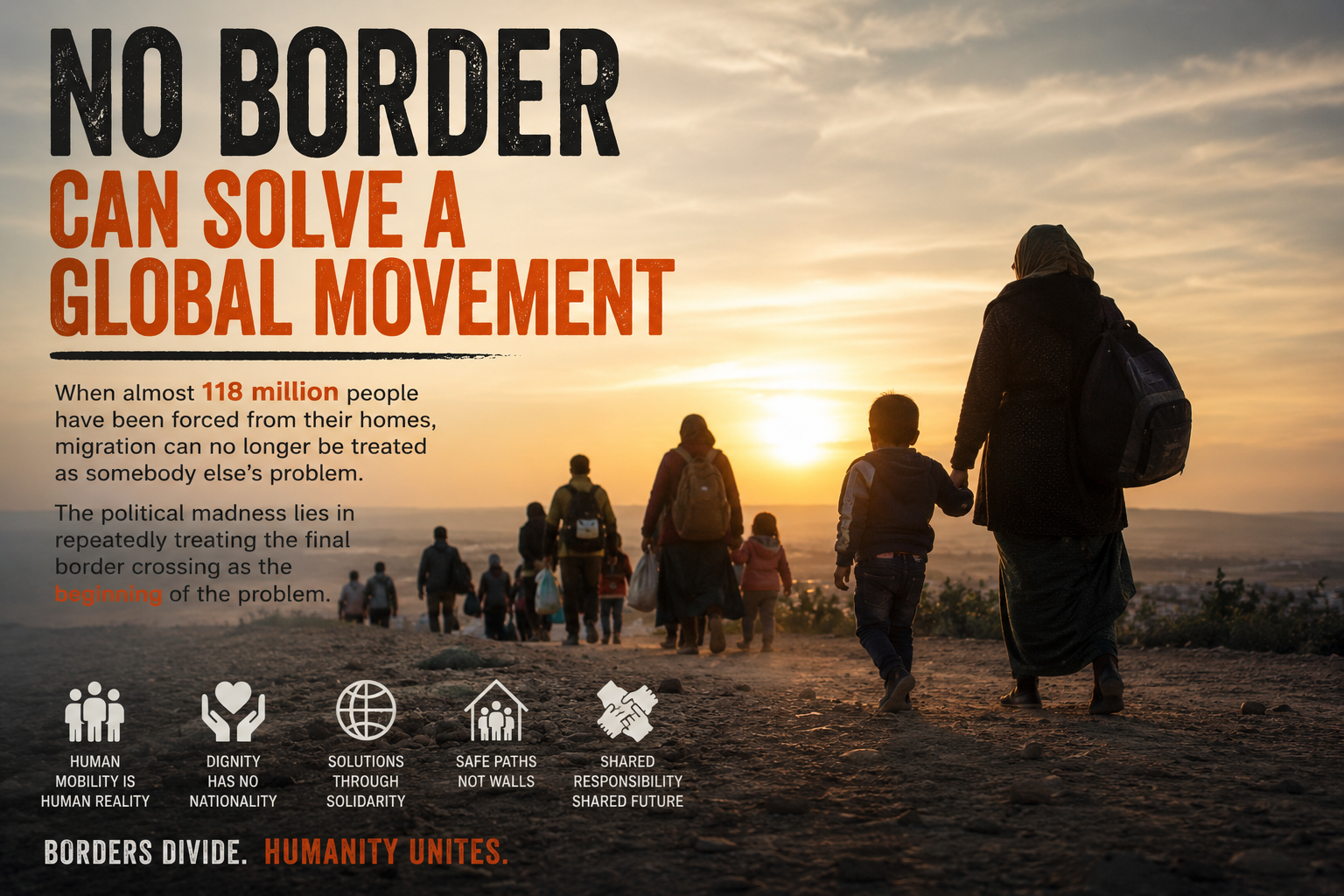
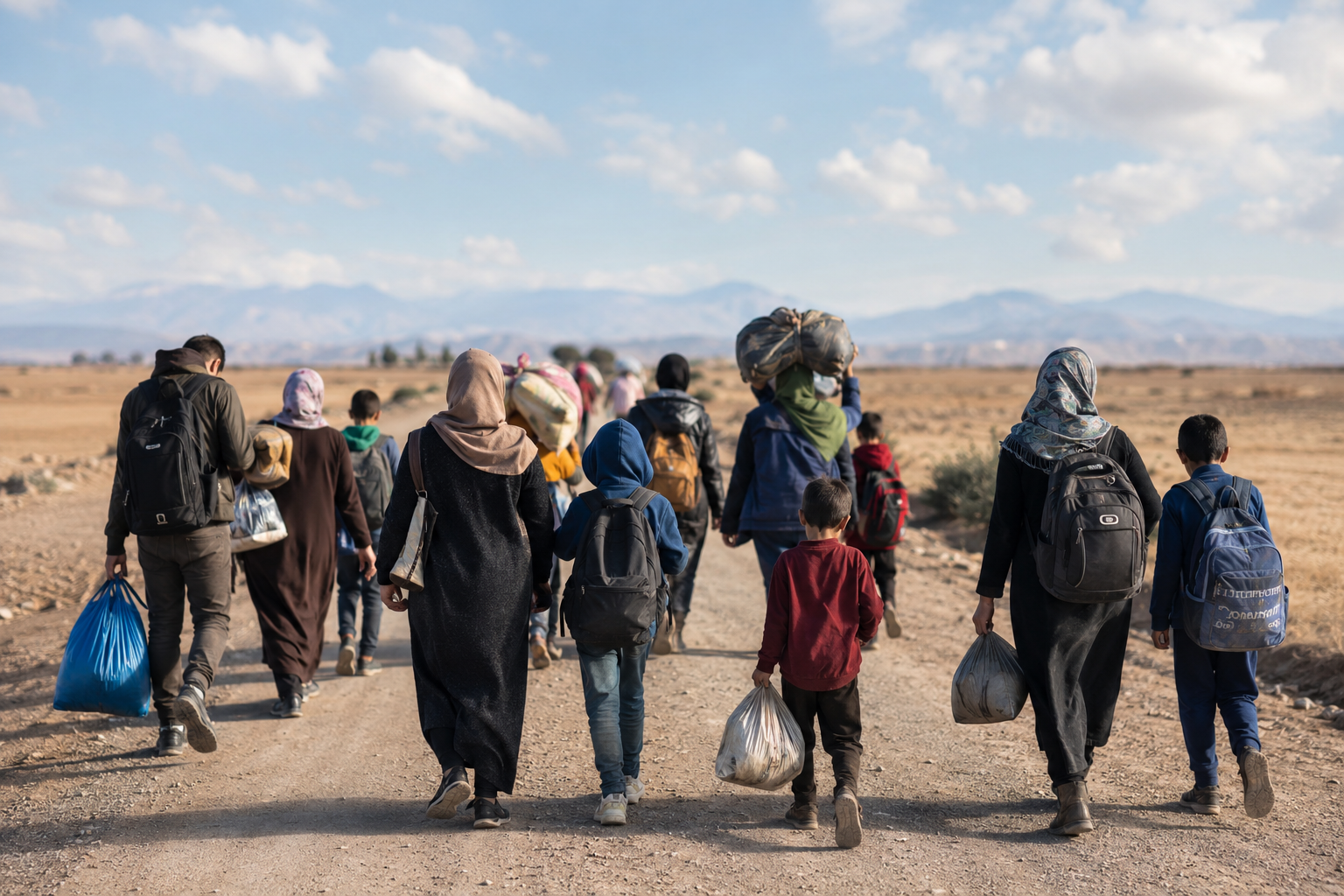
We see the images repeatedly. An overcrowded boat crossing the English Channel. People attempting the dangerous journey from North Africa towards Spain. Families walking across borders with whatever they can carry. Communities displaced by war, persecution, political collapse, drought, flooding or the destruction of their livelihoods.
Each story appears local. France and the United Kingdom debate the Channel. Spain and Morocco discuss their maritime border. Countries across Europe, Africa, Asia and the Americas tighten controls, change asylum rules and promise stronger enforcement.
But the movement of people is not a collection of isolated national problems. It is one global human reality.
One distinction matters before any numbers. Forced displacement and migration are not interchangeable. Their causes, legal status and policy responses differ, although individual journeys may involve several overlapping pressures. The figures that follow describe forced displacement, not all international movement.
At the end of 2025, an estimated 117.8 million people worldwide were forcibly displaced by conflict, persecution, violence, human rights violations or events seriously disturbing public order. That is roughly one person in every 70 on Earth.
The number fell from 123.2 million a year earlier, largely because of large-scale returns to Afghanistan, Syria and Sudan, many of them under difficult and insecure conditions. A decline is welcome. It does not make the scale remotely normal, and it does not mean the pressures behind displacement have eased.
117.8 million people forcibly displaced worldwide. 68.7 million displaced within their own countries. 41.6 million refugees. 9 million people awaiting decisions on asylum claims.
Most of these people have not crossed an international border. Some 68.7 million remained displaced within their own countries. There were also 41.6 million refugees and 9 million people awaiting decisions on asylum claims. These categories overlap and should not be added together as separate populations.
Behind every category is a person whose ordinary life has been interrupted.
The language matters
Public debate often places migrants, refugees, asylum-seekers and people living without regular immigration status into one political category. They are not the same.
Someone who moves from one place to another. That movement may be for work, education, family, safety or several reasons at once.
Someone outside their country who needs international protection because of persecution, conflict or serious threats to life and freedom.
Someone asking another country to recognise that need for protection. The claim has not yet been finally determined.
Someone forced from home who remains within their own country. Most displaced people worldwide fall into this group.
A person without the required permission to enter or remain. Conduct can be unlawful. A human being is not.
People displaced by disasters do not automatically qualify as refugees under international law, although environmental disruption intensifies other pressures.
Describing a person as "illegal" reduces an entire human being to an administrative status. Seeking asylum is itself a recognised right. It does not mean that every application must succeed, but it does mean that each claim should receive a fair and timely assessment.
People displaced by disasters or climate-related pressures do not automatically qualify as refugees under international law, although environmental disruption can intensify conflict, insecurity and economic collapse.
These distinctions are not exercises in political correctness. They are necessary if governments are to apply the law properly and if societies are to discuss the issue honestly.
A system built for another age
The 1951 Refugee Convention emerged from the devastation of the Second World War. It defined who qualified as a refugee and established essential protections, including the principle that people must not be returned to a place where their life or freedom would be threatened.
The Convention was initially limited principally to European displacement arising before 1951. Its 1967 Protocol removed those geographical and temporal limits, allowing the framework to respond to new refugee situations worldwide. Today, 149 states are parties to the Convention, the Protocol or both.
The Convention remains vital. Its weakness is not that protecting refugees has become outdated. Its weakness is that international cooperation has failed to develop at the same pace as the forces driving displacement.
Wars have become prolonged. Governments have collapsed. Climate-related disasters are disrupting livelihoods and multiplying existing pressures. Legal routes for employment and family reunion often remain slow or inaccessible. Asylum systems carry enormous backlogs. Organised criminal groups exploit desperation. Local communities are asked to absorb rapid change without enough housing, services or honest political leadership.
We have watched these pressures grow for decades. Yet much of the political response still arrives as an emergency announcement, a new barrier or a promise that one country will somehow regain control by acting alone.
International frameworks for cooperation already exist, including the 2018 Global Compact on Refugees and the Global Compact for Safe, Orderly and Regular Migration. The missing element is not another declaration of principle, but sustained implementation, adequate funding and political courage. The 1951 Convention was never designed to be a complete system for managing global migration, and no single treaty could be.
Borders are real, but they are not solutions
Governments have a legitimate responsibility to manage their borders.
They must know who is entering. They must address security threats, organised crime and exploitation. They must plan for housing, healthcare, education and employment. They must decide claims efficiently and return people who have no lawful right to remain, provided those returns are safe, lawful and humane.
Ignoring these responsibilities damages public confidence. It also gives space to those who profit politically from fear.
But border enforcement cannot end forced displacement. It can redirect journeys, increase their price and make them more dangerous. It cannot persuade a parent to remain where their child may be killed. It cannot restore a flooded home, end a civil war or create employment in a collapsed economy.
When doing nothing appears more dangerous than crossing a desert or boarding an unsuitable boat, people will move.
That is not madness. It is survival. The political madness lies in repeatedly treating the final border crossing as the beginning of the problem.
Most refugees are not hosted by the richest countries
The public debate in wealthier states often creates the impression that they carry the greater part of the global responsibility. The evidence tells a different story.
At the end of 2025, 68 per cent of refugees and other people needing international protection were hosted by low- and middle-income countries. Some 65 per cent lived in countries neighbouring their countries of origin, and more than a quarter were hosted by the world's least developed countries.
This means that countries with fewer resources frequently provide protection to the greatest numbers.
It also shows why the language of "keeping people in their region" can be deeply misleading. In most cases, neighbouring countries are already doing precisely what wealthier countries demand of them, often without sufficient international funding or long-term support.
Responsibility-sharing cannot mean paying another country to make displaced people less visible.
What a serious response would require
There is no single solution. There is, however, a coherent direction.
The international community must invest more seriously in preventing and resolving conflicts, strengthening fragile institutions and helping communities withstand environmental and economic shocks.
Governments need faster and fairer asylum systems. Leaving people in uncertainty for years harms applicants, wastes public money and weakens confidence in the system.
More safe and lawful routes are also essential. These can include refugee resettlement, humanitarian admission, family reunion, education, employment and carefully managed mobility programmes. Safe routes will not eliminate every irregular journey, but they can reduce dependence on smugglers and allow governments to plan. The current gap is stark: during 2025, only 81,800 refugees worldwide arrived in new countries through resettlement or sponsorship pathways - around 3 per cent of the 2.9 million people UNHCR had identified as needing resettlement that year.
Countries must share responsibility more fairly. That includes financial support, resettlement places, technical capacity and meaningful assistance to the cities and communities receiving people.
Those who qualify for protection should be helped to participate in society as early as possible. Language, education, employment and contact with local people turn enforced waiting into human contribution.
People whose claims are refused also deserve clear decisions and dignified treatment. A credible system must be both humane and capable of reaching conclusions.
Above all, the world must stop discussing migration only after people reach a border. By then, almost every earlier opportunity has already been missed.
Understanding does not require open borders
People are entitled to ask difficult questions.
How many people can a community accommodate? Where will they live? How will schools and health services respond? How should governments distinguish genuine protection needs from other forms of movement? How can exploitation be stopped? What happens when an application is refused?
These are legitimate questions. Calling everyone who asks them hostile or prejudiced will not build understanding.
But fear cannot become permission to remove the humanity of others. Nor should concern about irregular migration be used to weaken the right to seek protection.
Understanding requires us to hold two truths together: communities need order, capacity and confidence, and displaced people retain their rights, dignity and individuality.
From national anxiety to shared responsibility
Human beings have always moved. We move towards safety, family, opportunity and hope. We move because wars begin, governments fail, economies change and the natural environment no longer supports the lives built upon it.
No country can manage these forces alone.
A border can regulate entry. It cannot stop war, persecution, climate disruption or human determination. A new national rule may change where people travel. It does not remove the reason they left.
The PTPI Reflection
For People to People International, this is where citizen diplomacy matters. Policies are made by governments, but the climate surrounding those policies is shaped by all of us. We can challenge misinformation. We can refuse dehumanising language. We can listen to the concerns of receiving communities without turning those concerns against people seeking safety. We can meet individuals rather than arguing only about categories.
Almost 118 million displaced people are not a temporary interruption to an otherwise stable world. They are evidence that our systems of peace, protection and international cooperation are under severe strain.
The question is no longer whether people will move.
The question is whether the world will manage that movement through cooperation, fairness and human dignity, or continue leaving frightened countries and desperate individuals to confront it alone.