When Debt Shrinks the Space Between People
The global debt debate is not only about markets, deficits and government budgets. It is also about who can learn, travel, volunteer, connect and take part in building peace.
Picture a student who has saved for two years to attend a youth leadership programme abroad. Then her government announces another round of spending cuts, and the programme disappears. As debt payments absorb more public revenue, opportunities created for her generation are sacrificed to obligations accumulated over many years.
She is not one person. Across much of the world, she is a pattern. And she is the reason PTPI believes the global debt story belongs on a peace organisation's news page.
A World Living on Borrowed Money
Public debt is the money governments owe to lenders at home and abroad. In 2024 it reached a record 102 trillion US dollars worldwide, close to the value of everything the world produces in a year. The International Monetary Fund puts it at just under 94 per cent of global output in 2025 and expects it to pass 100 per cent by 2029, its highest level since 1948.
Global public debt in 2024, a record high (UNCTAD)
Net interest paid by developing countries in 2024, up 10% in one year (UNCTAD)
People living in countries that spend more on interest than on health or education (UNCTAD)
That headline invites panic, but panic would be the wrong reading. The world has not run out of money, and most countries are not close to collapse. More than 100 countries hold public debt below 60 per cent of GDP. The pressure is concentrated in two very different places: major economies such as the United States, Japan, France and the United Kingdom, whose debts now exceed the size of their economies, and developing countries whose debts are smaller but far more expensive to carry.
The honest summary is this: the world is not bankrupt. It is increasingly constrained by what it has already promised, what it must now repay, and whose needs it chooses to protect.
Not All Debt Is Equal
Borrowing is not, by itself, a vice. Governments borrow to build schools, hospitals and railways, to respond to pandemics and floods, and to invest in future prosperity. Handled well, debt is a bridge between what a country needs today and what it can afford tomorrow.
Debt becomes harmful when it grows faster than national income, when borrowing becomes expensive, or when repayment starts to displace essential public investment. Since 2020, developing countries have borrowed at interest rates two to four times higher than those paid by the United States. The same loan buys less future for the countries that need it most.
One comparison makes the inequality concrete. The United States can carry debt exceeding the size of its economy while devoting around 12 per cent of government revenue to interest. Kenya's debt stood at roughly two thirds of its GDP in 2025, yet interest payments absorbed around one third of its tax revenue. The measures are not perfectly identical, but the contrast reveals something important: the burden of debt depends not only on how much a country owes, but on its borrowing costs, its revenue capacity and its position in the global financial system. In plain terms, it matters who you are when you borrow.
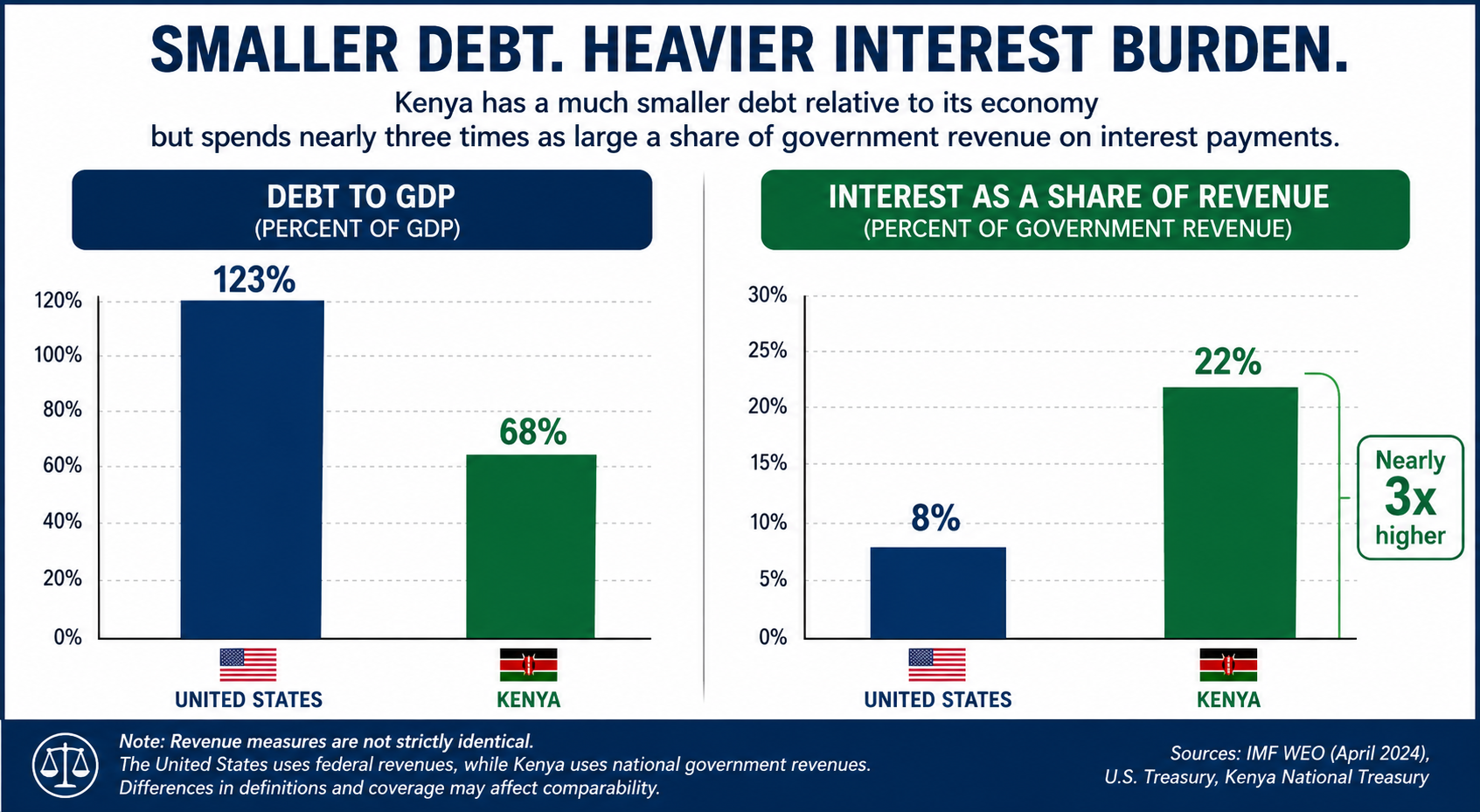
Note: the revenue measures are not strictly identical. The United States figure reflects interest as a share of government revenues as reported by UNCTAD for 2024; the Kenya figure reflects the World Bank's estimate that interest absorbs about a third of tax revenue. Differences in definitions and coverage may affect comparability. The contrast, not the decimal point, is the message.
When Repayment Replaces Possibility
Servicing debt simply means making the interest and repayment instalments that fall due. In 2024, developing countries paid 921 billion US dollars in net interest on their public debt, a rise of 10 per cent in a single year. A record 61 developing countries now spend at least one tenth of their government revenues on interest payments.
The most important figure is also the simplest, because it is human. Around 3.4 billion people, well over a third of humanity, live in countries that spend more on interest than on either health or education.
Behind that statistic sit ordinary decisions: a teacher who is not hired, a clinic that is not stocked, a youth centre that closes, an exchange programme that is quietly cancelled. And when interest payments crowd out investment in climate resilience, the cost is not only economic. It is environmental and human.
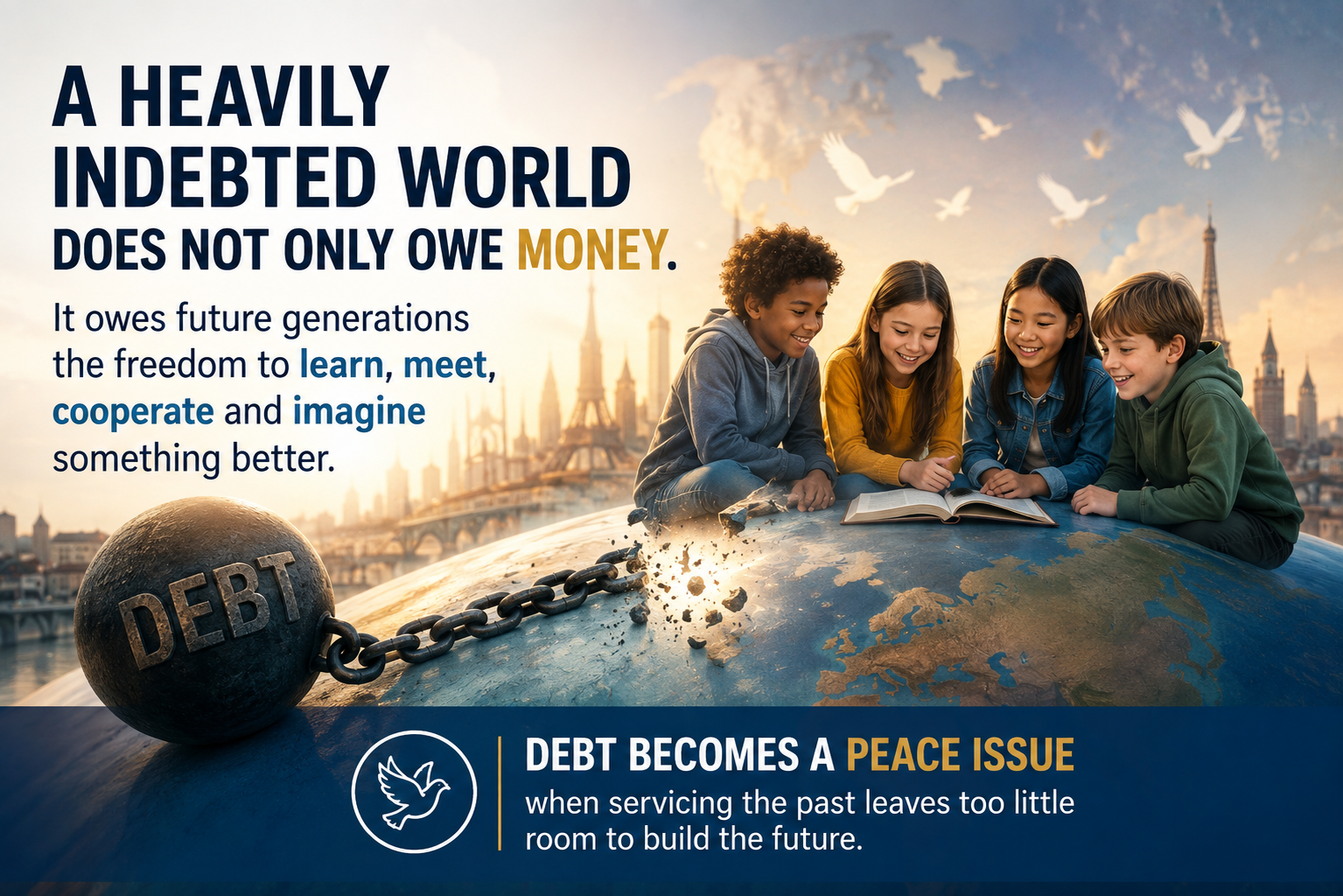
A heavily indebted world does not only owe money. It owes future generations the freedom to learn, meet, cooperate and imagine something better.
The Hidden Cost to Citizen Diplomacy
Citizen diplomacy is the everyday connection between people across borders that builds understanding, trust and peace. It relies on the freedom to travel, learn, volunteer and communicate. Debt is usually discussed as economics. At PTPI, we see it differently: as a barrier to exactly those freedoms.
When budgets tighten, these go first
- Education, youth programmes and cultural exchanges become easier to cut, because their benefits are long term and hard to measure.
- Disposable income shrinks, leaving families less room for travel, volunteering and community life.
- Charities compete harder for smaller donations, and small organisations feel it first.
- Communities can be affected too. Prolonged economic insecurity can deepen resentment and create fertile ground for scapegoating, polarisation and political extremism.
- International cooperation is portrayed as an unaffordable luxury rather than a necessity.
Sovereign debt is not the only financial pressure narrowing participation. At household level, student loans, housing costs and constrained incomes can produce a similar human result: international engagement becomes a privilege rather than a realistic possibility.
One further point deserves honesty. Citizen diplomacy cannot fulfil its promise if only comfortable, internationally minded citizens can afford to take part. The people most affected by mistrust, exclusion and economic insecurity are often the hardest for organisations like ours to reach. A world under financial strain makes that gap wider, not narrower.
What Remains Within Our Power
There is no single escape route from global debt, and it would be dishonest to pretend there is one. Credible responses include responsible borrowing, faster and fairer debt restructuring, stronger tax administration, action against corruption and illicit financial flows, and better taxation of multinational profits. There is movement on several of these fronts. The OECD global minimum tax now seeks to ensure that the largest multinational groups pay an effective rate of at least 15 per cent. Countries such as Zambia and Ghana have made substantial progress in restructuring their debt, although parts of both processes remained unfinished in 2026. Their experience shows that the system can move, but also how slow and demanding that movement can be. It is progress, not a cure.
PTPI cannot repair the global financial system. What we can do is refuse to let financial pressure define who belongs. That means creating lower cost ways to participate, supporting projects where small sums change lives, sharing knowledge freely, building partnerships that spread costs, and making sure that international friendship is never reserved for those who can most easily afford it.
Our work in Kenya shows what that looks like in practice. The PTPI Kenya Climate Education Programme, now in its seventh year, has reached more than 5,000 learners through locally led environmental education. Through the Adopt a Plant route, monthly contributions beginning at 1 euro allow people to support this work without requiring wealth, travel or a major financial commitment. Small contributions do not make the project small. They widen the circle of people able to take part.
Why This Matters to You
For many readers, debt is not an abstraction. It may be the reason you delayed a trip, chose a cheaper course, or wondered whether you could afford to stay involved. That is not a personal failing. It is a structural reality.
It is also a reason to stay engaged. The connections you build are precisely what governments under pressure cannot quantify and what future generations cannot afford to lose.
Debt becomes a peace issue when servicing the past leaves too little room to build the future. Making room is what PTPI exists to do.
Sources
IMF, Fiscal Monitor, April 2026 - global public debt at just under 94 per cent of GDP in 2025, projected to reach 100 per cent by 2029.
IMF, Fiscal Monitor, October 2025 - highest debt level since 1948; more than 100 countries with debt below 60 per cent of GDP; G20 economies with debt above 100 per cent of GDP.
UN Trade and Development (UNCTAD), A World of Debt 2025 - 102 trillion US dollars global public debt in 2024; 921 billion US dollars net interest paid by developing countries; 61 countries spending 10 per cent or more of revenues on interest; 3.4 billion people in countries spending more on interest than on health or education; borrowing costs two to four times US rates since 2020; US interest equivalent to 12 per cent of government revenues in 2024.
World Bank, Kenya Economic Update, May 2025 - interest payments absorbing about a third of Kenya's tax revenue. Kenya National Treasury, Annual Public Debt Report 2024-2025 - public debt at 67.8 per cent of GDP at end June 2025.
IMF, Global Sovereign Debt Roundtable, Co-Chairs Progress Report, April 2026 - status of the Zambia and Ghana restructurings.
OECD, Global minimum tax - effective minimum rate of 15 per cent for large multinational groups.