
When Pride Draws a Border
The 2026 World Cup showed the extraordinary power of national belonging. It also showed how quickly pride can turn hostile. Loving where we come from does not require fearing, insulting or diminishing anyone else.
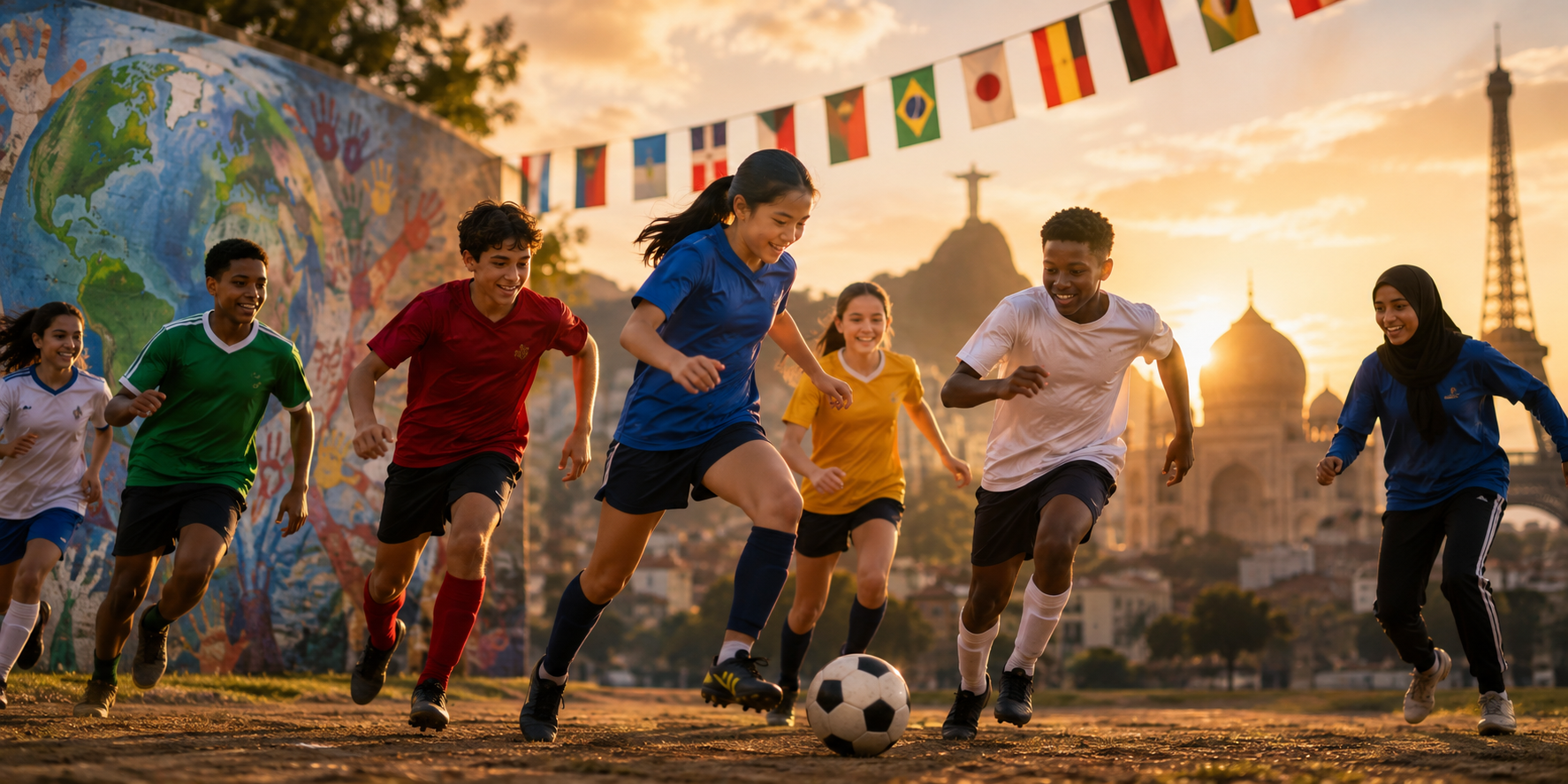
Forty-eight nations. Three host countries. More than 6.8 million spectators, the highest attendance in World Cup history, with fans from 210 countries and territories in the stands and broadcast records falling in market after market. For nearly six weeks this summer, flags were everywhere.
It was an outpouring of pride that filled stadiums with joy and, for a determined minority, filled social media with hate.
The joy of belonging
Flags hung from balconies in the United States, Canada and Mexico and wrapped around shoulders in fan zones on every continent. Strangers embraced because eleven people wearing the same colours had scored a goal thousands of kilometres away. In a tournament spanning three countries, and communities speaking English, French, Spanish and many Indigenous and migrant languages, belonging itself was multilingual.
There is nothing wrong with any of this. A World Cup is one of the few remaining occasions when an entire country feels the same thing at the same moment. Identity, memory, security and recognition are not weaknesses to be trained out of people. They are the raw material of community.
The moment pride changes character
Yet the same tournament produced discriminatory abuse, objects thrown by supporters, political provocation and confrontation on and around the pitch. Pride did not cause every incident. Alcohol, crowd behaviour, policing and individual aggression all played their part. But the contrast raises an uncomfortable question: when does love of us begin to require an enemy called them?
The distinction is older than this tournament. George Orwell, writing in 1945, separated patriotism, a devotion to a particular place and way of life, from nationalism, the hunger for one's own nation to gain power and prestige at others' expense. The difference is not whether someone waves a flag. It is what the flag comes to mean. Healthy patriotism says: I value my country, my culture and my community. Nationalism begins to darken when it says: my country matters more because yours matters less. Extremism takes the final step: those who do not belong are a threat.
This is not an automatic progression. The overwhelming majority of those millions celebrated peacefully. But the line between the first statement and the second is thinner than most of us like to believe, and most of us cross it occasionally without noticing.
What the World Cup revealed
The evidence from this tournament is not anecdotal.
FIFA reported that its Social Media Protection Service, which combines artificial intelligence with human moderation in more than fifty languages, moderated over 53 million posts and comments during the tournament and intercepted more than seven million potentially harmful or abusive posts, a fourteen-fold increase on the 2022 World Cup. Human analysts assessed more than half a million AI-detected messages aimed at players, coaches and officials, escalating over 15,000 for further action and referring more than 1,000 serious threats to the relevant authorities. During the group stage, FIFA reported that more than one in ten detected abusive posts was racially motivated, the largest single category. The figures are FIFA's own, indicators rather than a complete measure, but they open a remarkable window onto what national passion looks like online.
Off the screen, FIFA has opened disciplinary proceedings against Argentina's football association and players. The alleged breaches include discriminatory chants and gestures, team misconduct, security failures, objects thrown by supporters across several matches, the display of a banner asserting territorial sovereignty over the Falkland Islands during the semi-final celebration against England, and alleged misconduct following the final, which Spain won in extra time. All remain allegations; FIFA's disciplinary committee has yet to rule.
Nor was one country's pride uniquely fragile. After the Netherlands were eliminated, the Dutch football association filed a complaint with public prosecutors over racist messages directed at its own players. Defeat can reveal whether pride is resilient enough to accept disappointment without searching for an enemy.
Hold both truths at once. The tournament created joy, friendship and shared experience on an enormous scale. It also showed, in unusually measurable form, how quickly collective pride can curdle into abuse.
Why defeat can feel personal
These incidents are visible and countable. The most chilling evidence of nationalism's fragility, however, is not found in a stadium. It is found in the quiet, violent aftermath of a lost match.
A study published in the Journal of Peace Research examined years of results involving the German national football team alongside recorded attacks against immigrants in Germany. In the days immediately following a defeat, attacks against immigrants rose significantly. After a victory, attacks appeared to fall, although that effect was smaller and less statistically certain. Careful testing showed the increase after defeats was specific to attacks on immigrants and not part of a general rise in violence.
Sit with that finding for a moment. A missed penalty in one city is followed, days later, by an assault on a person in another city who had nothing to do with the match. When our group is part of our identity, the group's defeat feels like a personal injury. Most people absorb that injury and move on. A small minority look for someone to blame, and they reach for the oldest answer available: the outsider.
This is the intellectual hinge of the whole subject. National feeling is not dangerous because it is strong. It becomes dangerous when it is fragile, when belonging is so bound up with winning that losing demands a culprit.
The nationalism already around us
National feeling is not dangerous because it is strong. It becomes dangerous when it is fragile.
It would be comfortable to treat all of this as a football problem. It is not. Sport merely concentrates, in ninety minutes, emotions that circulate through ordinary life all the time. Television framing that treats every international question as a contest. Political language that describes compromise as surrender. Selective history that remembers our victories and their crimes. Social media feeds that reward outrage over accuracy.
None of these announce themselves as nationalism. They arrive as entertainment, as news, as common sense. That is precisely why their influence can be difficult to recognise in ourselves.
Travel is not enough
The usual prescription is contact: travel more, meet more people, and prejudice will dissolve. The truth is less convenient. International travel does not automatically create understanding. People can cross borders carrying every assumption they left home with, photographing a culture from the outside without ever being changed by it.
Social psychology has studied this since the 1950s. Gordon Allport argued that contact is most effective when people meet with equal status, pursue shared goals, cooperate meaningfully and receive support from the institutions around them. A landmark 2006 meta-analysis by Thomas Pettigrew and Linda Tropp, drawing on more than 500 studies, found that intergroup contact generally reduces prejudice, with these supportive conditions making positive outcomes more likely. Brief or highly commercial forms of tourism may provide little opportunity for those deeper conditions to develop.
Well-designed people-to-people exchange deliberately creates more of these conditions: mutual participation, shared purpose, cooperation and institutional support. Sustained contact rather than brief observation. Conversation rather than assumption. Shared tasks rather than parallel lives.
For nearly seventy years, this has been PTPI's working method. The organisation does not ask anyone to become less Polish, Belgian, American, Kenyan, Japanese or Danish. It asks whether we can be deeply rooted in our own identity while remaining genuinely curious about somebody else's. That is a stronger idea than simply telling people to be global citizens. People need roots. Peace depends on ensuring that those roots do not become walls.
A better form of pride
Peace does not require us to abandon our flags, languages, loyalties or memories. It requires us to understand that other people carry attachments just as deep as our own.
The challenge is not to feel less. It is to ensure that our strongest feelings do not narrow our humanity.
A flag can mark where we come from. It should never determine whose dignity matters.
Questions for every chapter: when has pride in your country or culture helped you connect with someone from elsewhere? When has it made connection harder? Send your answers to office@ptpi.network. The conversation is the point.